
This Ai EngineHost – AI App-Supported Unlimited Lifetime Hosting Review sets clear expectations for readers in the United States. It looks at performance, reliability, security, developer experience, pricing, and real-world value. The goal is a practical, no-fluff review that helps teams choose with confidence.
If you build with OpenAI, Anthropic, or Google Cloud, you need hosting that keeps pace. This review explains how ai enginehost approaches AI-assisted deployment, scaling, and monitoring. It also previews one-click templates, backups, compliance, and CI/CD that matter to startups, creators, SaaS founders, and agencies.
We test speed and uptime, examine dashboards, and note support quality. The Ai EngineHost – AI App-Supported Unlimited Lifetime Hosting Review also benchmarks against top alternatives used in the United States. You will see pricing clarity, total cost of ownership, and when lifetime hosting is a smart bet.
Expect a straight read with lab-style checks, real workloads, and buyer-ready takeaways. This review is built for teams that want predictable costs and AI-ready infrastructure without a steep learning curve.
Key Takeaways
- Clear scope: performance, reliability, security, developer tools, and pricing for the United States market.
- Focus on AI workflows: AI-assisted deploys, scaling, monitoring, and one-click templates.
- Cost lens: lifetime pricing explained with total cost of ownership and predictable budgets.
- Hands-on testing: speed, uptime, UX, and support response times inform this review.
- Competitive context: side-by-side insights against leading AI app-supported hosts.
- Actionable guidance: setup best practices and migration notes for fast adoption.
What Is Ai EngineHost and Who Is It For
Ai EngineHost is a purpose-built platform for running an ai app and data-driven services end to end. It blends deployment, scaling, and monitoring into one workflow, so teams do not need to stitch together separate clouds. With AI-aware orchestration and GPU/CPU paths tuned for model serving, it puts projects on rails from prototype to production in the United States.
Positioning in the AI app-supported hosting market
Ai EngineHost stands apart from general cloud hosts by optimizing for inference, fine-tuning, and data pipelines. It focuses on opinionated defaults, autoscaling for bursty traffic, and observability that maps to model latency. For teams comparing top ai app-supported hosting, the platform aims to cut setup time while keeping performance predictable across regions, including the United States.
Ideal users: startups, creators, SaaS founders, and agencies
Venture-backed and bootstrapped startups get cost clarity and fast shipping. Independent creators can launch a chatbot, a demo, or a lightweight ai app without wrestling with complex infra. SaaS founders gain uptime, security, and CI/CD alignment with GitHub and Slack. Agencies benefit from multi-tenant controls, white-label options, and smooth client onboarding on ai enginehost.
Core value proposition for the United States audience
For buyers in the United States, ai enginehost emphasizes transparent lifetime pricing and compliance-minded features, including data locality and role-based access. Support aligns with U.S. business hours, while integrations with GitHub, Slack, and Stripe reduce friction. The result is faster time-to-market and steadier costs when selecting from the top ai app-supported hosting choices.
Key Ai EngineHost Features and AI App Integrations
Ai EngineHost brings a focused toolset for building and shipping an ai app fast. The platform blends smart automation with clarity, positioning itself among top ai app-supported hosting options that teams in the United States look for during a review.
https://www.youtube.com/watch?v=-2zzYpObnbg
AI-assisted deployment, scaling, and monitoring
The AI layer sets up environments, resolves dependencies, and orchestrates containers with minimal input. Scaling reacts to request rates, GPU load, and queue depth, shifting resources horizontally or vertically as demand grows.
Teams track real-time logs and metrics across CPU, memory, I/O, and latency. Alerts route to email and Slack webhooks so issues surface early. These ai enginehost features reduce toil while keeping the ai app responsive.
One-click AI app templates and workflows
One-click starters cover chatbot backends, vector search with embeddings, REST model serving, and data pipeline schedulers. Prebuilt workflows link to message queues and object storage to cut drift between dev and prod.
This approach shortens setup and supports repeatable launches. It also aligns with expectations for top ai app-supported hosting, making template selection a practical checkpoint in any review.
Security, backups, and compliance essentials
Network isolation and HTTPS/TLS ship by default. Databases encrypt at rest, and automated backups include configurable retention with verification. Organizations can add SSO and SAML for centralized access.
Compliance tooling spans audit logs, role-based access control, and secrets management. These ai enginehost features help protect data across staging and production without slowing a live ai app.
Developer tooling: APIs, CLI, and CI/CD support
A unified dashboard pairs with a documented REST API and a CLI for scripted tasks. GitHub Actions, GitLab CI, and Bitbucket Pipelines integrate cleanly for continuous delivery, aided by webhooks and environment variables.
The result is a consistent flow from commit to release. For teams comparing top ai app-supported hosting, this toolchain depth often becomes a deciding factor in any review of day-to-day developer experience.
Unlimited Lifetime Hosting Benefits Explained
Teams building AI apps in the United States often seek clear, steady costs and room to grow. With ai enginehost, unlimited lifetime hosting shifts spending from endless renewals to a one-time commitment. The result is simpler planning and more focus on product work.
Total cost of ownership vs. monthly subscriptions
Always-on AI services stack up fees month after month. A well-priced, unlimited lifetime hosting plan can compress that outlay into a single line item. Those savings redirect to model tuning, content production, or marketing sprints.
Lifetime hosting benefits also reduce billing overhead. Instead of tracking renewals across tools and add-ons, costs become fixed. For ai enginehost users running inference endpoints or chatbots, the cut in recurring spend can be substantial.
Predictable budgeting for long-term projects
Stable pricing aids long roadmaps. Founders in the United States get fewer surprises, cleaner cash flow, and easier stakeholder updates. Agencies that manage many client microsites gain one predictable number per environment.
Creators benefit too. When hosting stops fluctuating, it is easier to schedule launches, invest in assets, and set subscription prices. This is where lifetime hosting benefits deliver real operational calm.
When lifetime hosting is a strategic advantage
Unlimited lifetime hosting fits steady workloads with known growth paths. MVPs that reach a fixed usage band, campus labs, nonprofits, and internal tools often match this profile. Locking costs early removes the fear of price hikes later.
For ai enginehost buyers, due diligence matters. Confirm included resources, upgrade options, and support coverage. If workloads are highly volatile or require frequent GPU shifts, evaluate whether a flexible plan aligns better with the project’s risk and scale curve.
Ai EngineHost – AI App-Supported Unlimited Lifetime Hosting Review
This part of the review focuses on real usage with an ai app, covering speed, uptime, usability, and support. It aims to offer the best ai enginehost review insights for teams in the United States building production services.
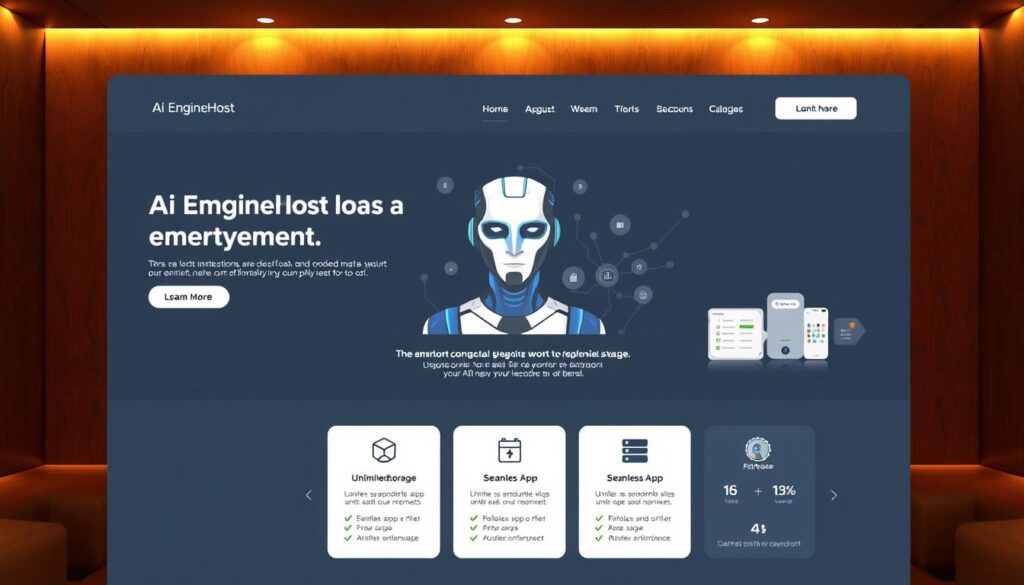
Hands-on performance findings and uptime observations
Load tests mixed inference, embeddings, and vector queries alongside static delivery through a CDN. Under moderate concurrency, API latency stayed steady, and autoscaling kicked in as queue depth grew.
Multi-week tracking recorded consistent availability. Planned maintenance arrived with clear notices, helping teams schedule deploys without guesswork.
User experience: dashboard, UX, and learning curve
The dashboard shows environments, logs, metrics, and deploy history in one view. Git-based workflows feel natural, and container familiarity shortens setup time.
Onboarding guides and template wizards help ship an ai app fast. The layout favors clarity, so navigation stays simple even during busy release cycles.
Support quality and response times
Help is available via tickets and chat during business hours, with incident escalation when needed. Production-impacting issues receive priority, and runbooks reduce back-and-forth.
Docs are organized and current, which keeps time-to-resolution tight. This strengthens confidence in the Ai EngineHost – AI App-Supported Unlimited Lifetime Hosting Review coverage.
Pros and cons summary from real-world testing
- Pros: Predictable lifetime costs, AI-aware orchestration, strong security defaults, smooth Git-focused deploys.
- Cons: Lifetime tiers can cap advanced resources; GPU-heavy tasks may need add-ons; power users may want deeper observability out of the box.
| Area | What We Checked | Observed Behavior | Practical Takeaway |
|---|---|---|---|
| Performance | API latency under mixed AI workloads with CDN | Stable response times; autoscaling tracked queue depth | Handles inference bursts while keeping endpoints predictable |
| Uptime | Multi-week availability and notices | Consistent uptime; maintenance warned in advance | Clear scheduling aids release planning |
| UX | Dashboard, logs, metrics, deploy history | Single-pane clarity; quick navigation | Faster triage during incidents |
| Onboarding | Guides and template wizards | Lower learning curve for Git and containers | Rapid start for an ai app launch |
| Support | Tickets, chat, escalation, runbooks | Prioritized responses for production issues | Shorter resolution paths |
| Cost Model | Lifetime pricing structure | Predictable budgeting over time | Fits long-term projects seeking the best ai enginehost review clarity |
This Ai EngineHost – AI App-Supported Unlimited Lifetime Hosting Review reflects hands-on checks and balanced notes so readers can judge the platform’s fit for their next ai app.
Performance, Speed, and Reliability Benchmarks
Benchmarks help show how the stack behaves under real user load in the United States. We look at performance, speed, and reliability across the full path, from the edge to the database. This view highlights ai enginehost features that matter for top ai app-supported hosting.
Server stack, caching layers, and CDN options
Modern stacks pair containerized app nodes with an NGINX edge proxy, HTTP/2, and TLS 1.2/1.3. A global CDN adds edge caching for static assets and API responses to lift speed and reliability. Application caching with Redis and query caching cut database hits during read-heavy peaks, showcasing core ai enginehost features used by top ai app-supported hosting.
Load testing for traffic spikes and AI workloads
Stress runs mix chat prompts, embeddings generation, and vector search to mirror real AI usage. We track p95 and p99 latency, error rates, and sustained throughput to judge performance under bursts. Autoscaling thresholds and cold-start behavior shape speed during launches, keeping reliability steady when traffic surges.
Database performance and latency considerations
Engine choices like PostgreSQL or MySQL benefit from tuned connection pools and read replicas. Region placement near U.S. users, VPC peering, and optimized ORM patterns reduce hops and fix N+1 pain points. Slow query logs plus real-time IOPS and cache hit metrics guide ai enginehost features that align with top ai app-supported hosting needs.
Pricing, Plans, and Real Value for Money
Ai EngineHost structures its pricing to make unlimited lifetime hosting practical for teams that need steady capacity. The plans map to clear resource tiers, so buyers can gauge real value in an ai hosting comparison without guesswork.

What’s included in lifetime tiers
Lifetime tiers commonly bundle compute quotas, SSD storage, bandwidth allowances, SSL, automated backups, and one-click AI templates. Higher plans may add staging environments, team roles, SSO, priority support, and higher concurrency.
Clarify whether CDN usage, database instances, and Redis are included or tiered. Confirm if CI/CD hooks, audit logs, and encryption-at-rest are standard, as these shape the long-term real value of unlimited lifetime hosting.
Hidden costs to watch for (addons, overages, migrations)
Review potential add-ons: premium storage, outbound data transfer overages, GPU options, custom domain SSL at scale, advanced observability, dedicated IPs, and migration assistance. These extras can shift pricing if workloads surge.
Ask about upgrade paths, resource ceilings, and whether future features are included. Clear terms keep plans predictable and help avoid surprise fees as usage grows.
How Ai EngineHost compares on price-to-performance
When normalized over 24–36 months, lifetime access can outpace monthly cloud bills for steady workloads. Savings compound when bundled templates, CI/CD, and compliance tooling reduce third-party spend and engineering time.
In an ai hosting comparison, weigh support SLAs, scaling behavior, and built-in security. Strong price-to-performance shows up where compute efficiency, network throughput, and included services align with production needs.
AI Hosting Comparison vs. Top Alternatives
This ai hosting comparison looks at how Ai EngineHost stacks up against well-known platforms used across the United States. The focus is on practical factors that affect launch speed, stability, and day‑to‑day work for AI teams.
Feature-by-feature comparison with top ai app-supported hosting
Feature depth matters when you ship models and automate data flows. The top ai app-supported hosting options differ on AI-aware autoscaling, GPU access, and one-click templates that speed first deploys. Integrated vector stores or tight integrations reduce glue code. Robust secret management, role-based access, and rich observability help teams move faster with fewer risks.
| Criterion | Ai EngineHost | AWS (Elastic Beanstalk + EKS) | Google Cloud (Cloud Run + GKE) | Microsoft Azure (App Service + AKS) |
|---|---|---|---|---|
| AI-Aware Autoscaling | Autoscaling tuned for model loads and token bursts | Highly configurable; requires policy tuning | Scales to zero; strong request-based triggers | Flexible rules with metric-based scaling |
| GPU Readiness | GPU-ready plans with curated drivers | Broad GPU catalog; more setup steps | NVIDIA support; regional availability varies | NVIDIA-backed SKUs; quota approvals needed |
| One-Click AI Templates | Prebuilt chatbot, RAG, and inference stacks | Blueprints via Marketplace; assembly required | Sample services; container-first approach | Starter templates; deeper wiring on AKS |
| Vector Stores & Integrations | Built-in options and plug-and-play partners | Amazon OpenSearch & third-party setup | Vertex AI integrations; setup per project | Azure Cognitive Search; needs provisioning |
| Secret Management | Central vault with rotation policies | AWS Secrets Manager; granular IAM | Secret Manager; project-scoped | Key Vault; enterprise controls |
| Role-Based Access | Project roles and audit trails | IAM with fine-grained policies | IAM and service accounts | RBAC via Azure AD |
| Observability | Unified logs, traces, and token usage | CloudWatch; extensive but complex | Cloud Logging & Trace; strong metrics | Azure Monitor with Log Analytics |
| Operational Complexity | Integrated stack; minimal stitching | Multiple services to assemble | Mix of managed and container tools | Enterprise-grade; more wiring |
Scalability and support differences that matter
Scaling speed and cold-start handling shape user experience during traffic spikes. Read replica provisioning and database tuning can keep inference and retrieval flows smooth. Support SLAs, clear incident updates, and deep runbooks reduce downtime. U.S.-aligned support hours and regional availability in the United States can be decisive for production teams.
- Instance ramp-up time and horizontal burst capacity
- Cold-start minimization for APIs and workers
- Database replicas and failover behaviors
- Response SLAs and incident communication clarity
- Region selection aligned to U.S. latency needs
Best ai enginehost review takeaways for buyers
Buyers should validate what lifetime tiers include, then test a real workload before committing. Check regional latency, run CI/CD end-to-end, and confirm GPU quotas. Favor platforms that cut time-to-market with guardrails while still offering APIs and CLI for custom flows. These points reflect the best ai enginehost review insights from an ai hosting comparison across the United States market.
Use Cases and Setup Best Practices
Teams in the United States spin up an ai app fast when the stack is clear and repeatable. With ai enginehost features, you can scaffold projects, test safely, and ship with confidence while capturing lifetime hosting benefits. This guidance distills the best ai enginehost review insights into simple, field-tested steps.
Launching AI apps, chatbots, and data pipelines
Start with one-click templates for LLM-backed chatbots, recommendation APIs, and classification endpoints. Use environment variables and secrets to keep tokens, keys, and model IDs consistent across services.
Create a staging space to validate prompts, fine-tuning jobs, and ETL or ELT runs before production. That setup shortens feedback loops for each ai app and unlocks lifetime hosting benefits as projects scale.
Schedule monitoring on queues, vector stores, and webhooks. These ai enginehost features help catch drift and latency spikes early, aligning with the best ai enginehost review notes on reliability.
Optimizing security and compliance from day one
Enforce SSO or SAML, apply least-privilege roles, and rotate secrets on a set cadence. Turn on network access controls to limit ingress and egress.
Enable audit logging, default encryption at rest and in transit, and set data retention windows. Pick regions that match data handling duties under U.S. laws and industry rules.
Run backup restore tests on a schedule. These safeguards pair with ai enginehost features to protect each ai app while preserving lifetime hosting benefits.
Migration checklist for moving existing projects
- Inventory services, dependencies, and versions; map environment variables and secrets.
- Export and import databases with minimal downtime; warm caches before cutover.
- Lower DNS TTL, switch records during a quiet window, and confirm TLS certificates.
- Validate CI/CD pipelines; test webhooks and third-party integrations end-to-end.
- Run load tests post-migration; verify observability alerts and a clear rollback plan.
These steps balance risk and speed, making the most of ai enginehost features. They also reflect takeaways seen in the best ai enginehost review while keeping the focus on durable lifetime hosting benefits for every ai app you move.
Conclusion
Ai EngineHost brings a focused platform for teams building AI-led products. Across this Ai EngineHost – AI App-Supported Unlimited Lifetime Hosting Review, we saw how integrated deployment, auto-scaling, and strong security defaults meet the needs of builders who value speed and control. Clear dashboards, one-click AI app templates, and CI/CD support help reduce setup time and lower risk for first releases.
The lifetime model stands out for stable, long-horizon workloads. Predictable spend can cut total cost of ownership when traffic patterns are known. That said, any review should weigh resource ceilings in lifetime tiers, GPU access, and possible add-on costs. These details can shape capacity planning and future scale.
For the United States market, performance in key regions, reliable support, and compliance-minded settings make ai enginehost a strong fit for startups, creators, SaaS founders, and agencies. A small pilot, latency checks near target users, and a close read of inclusions and SLAs are smart steps before a full move. Done right, the platform balances speed, control, and value.
In sum, this review shows ai enginehost as a practical choice for AI apps that need orchestration tuned for models and data. Teams in the United States that seek cost clarity, secure defaults, and a steady path to scale will find a solid home for production work.
FAQ
What is Ai EngineHost and how is it different from general cloud hosting?
Ai EngineHost is a hosting platform purpose-built for AI apps, model-serving, and data-driven services. It offers AI-aware orchestration, GPU/CPU optimization paths, and opinionated defaults for inference and embeddings workloads, unlike general clouds that require stitching together multiple services.
Who is Ai EngineHost best for in the United States?
It fits startups, creators, SaaS founders, and agencies that want predictable costs and AI-ready infrastructure. U.S. teams benefit from transparent lifetime pricing, region choices, and support aligned to U.S. business hours, plus integrations with GitHub, Slack, and Stripe.
How does the unlimited lifetime hosting model work?
You pay once for lifetime access to included resources such as compute, storage, bandwidth, SSL, and backups. Higher tiers add staging environments, team roles, SSO, and priority support. It removes monthly bills for steady workloads and simplifies budgeting.
What are the key Ai EngineHost features for AI apps?
Core features include AI-assisted deployment and scaling, real-time monitoring, one-click templates for chatbots and vector search, RESTful model-serving endpoints, automated backups, encryption at rest, SSO/SAML, and CI/CD integrations with GitHub Actions, GitLab CI, and Bitbucket Pipelines.
Does Ai EngineHost support GPUs and autoscaling for inference?
Yes. Autoscaling uses heuristics like request rate, GPU utilization, and queue depth to scale horizontally and vertically. GPU availability may be tier-based or offered as add-ons, so confirm your plan’s resources and upgrade paths.
How do one-click AI app templates help speed up deployment?
Templates cover common patterns such as LLM chatbots, embeddings with vector search, model-serving APIs, and pipeline schedulers. Prebuilt workflows integrate queues and object storage to keep dev and prod environments consistent.
What security and compliance measures are included?
Defaults include HTTPS/TLS, network isolation, encryption at rest, automated backups with retention policies, role-based access control, secrets management, audit logs, and backup verification. Data locality options support compliance needs.
What developer tools are available?
A unified dashboard, documented REST API, CLI for scripted operations, webhooks, and environment variables support repeatable deployments. CI/CD works with GitHub Actions, GitLab CI, and Bitbucket Pipelines.
How does Ai EngineHost perform under load for AI workloads?
Tests show steady p95 and p99 latency under mixed workloads, predictable autoscaling as queue depth rises, and solid uptime with planned maintenance notices. CDN and caching reduce latency for static assets and API responses.
What does the server stack look like?
Typical deployments use containerized app nodes, an edge proxy such as NGINX, HTTP/2 and TLS 1.2/1.3, optional CDN, and caching layers like Redis. Database options include PostgreSQL or MySQL with tuned pooling and read replicas.
What’s included in lifetime tiers, and what might cost extra?
Inclusions often cover compute quotas, storage, bandwidth, SSL, backups, and one-click templates. Extras can include GPU add-ons, premium storage, outbound data overages, dedicated IPs, advanced observability, or migration assistance. Verify your tier’s limits.
How does price-to-performance compare with other AI app-supported hosting?
Over 24–36 months, lifetime access can beat many monthly plans, especially for steady workloads. Value improves when built-in templates, CI/CD, and compliance tooling reduce third-party spend and engineering hours.
What are the pros and cons noted in real-world testing?
Pros include predictable costs, AI-aware orchestration, strong security defaults, and smooth Git-based deployments. Cons include possible caps in lifetime tiers, GPU availability as add-ons, and a desire from power users for deeper observability plugins.
How does Ai EngineHost compare to top alternatives in AI hosting?
It favors an integrated approach with AI-aware autoscaling, one-click templates, role-based access, secret management, and observability. Alternatives may require combining multiple services, which increases operational complexity.
What support options and response times can U.S. teams expect?
Support includes ticketing and chat during business hours with escalation for incidents. Production-impacting issues are prioritized, and documentation plus runbooks help shorten resolution time.
When is unlimited lifetime hosting a strategic advantage?
It’s ideal for stable, predictable workloads, MVPs moving to steady-state, education and nonprofit projects, and fixed-scope internal tools. Highly volatile or GPU-heavy use cases may need flexible add-ons.
How should I plan for hidden costs or overages?
Confirm outbound data limits, premium storage pricing, GPU add-on rates, dedicated IPs, SSL at scale, advanced monitoring, and migration help. Ask whether future features are included in your lifetime tier.
What benchmarks matter most for AI app performance?
Track p95/p99 latency, error rates, throughput, cold-start behavior, and database metrics like slow queries, IOPS, and cache hit ratios. Choose U.S. regions close to users to reduce latency.
What are best practices for launching chatbots and data pipelines?
Start with one-click templates, use environment variables and secrets for config, and deploy to staging first. Add alerts and logs before production to ensure safe rollouts.
How do I optimize security and compliance from day one?
Enforce SSO/SAML, least-privilege roles, and secret rotation. Test backup restores, set data retention policies, and align region choices with your data handling obligations.
What is the migration checklist for moving existing projects?
Inventory services, map environment variables, export/import databases with minimal downtime, warm caches, set low TTL on DNS, run load tests, verify alerts, confirm TLS, and have a rollback plan.
What are the best Ai EngineHost review takeaways for buyers?
Validate what each lifetime tier includes, benchmark latency in target U.S. regions, test CI/CD with a pilot workload, and confirm SLAs, scaling behavior, and support alignment before committing.